- Date: Saturday 2 ~ Sunday 3, November 2024
- Venue: Chonnam National University, Yeosu-si, South Korea
- Age group: Junior (~ 13yrs) and Senior (14yrs ~)
- Information download:
- Discussion Forum (text, voice, video): https://discord.gg/SCcacGD7
- Due to safety concerns, the venue will not offer recharging services for lithium batteries. We strongly recommend that students either use dry cell batteries or recharge their batteries outside the university premises. (Charging laptop computers are ok).
Categories Overview
Presentation Category (max 4 players per team)
- Innovative Technology Challenge
- Student Symposium
- Immersive Experience Challenge
Software Programming Category (Coding: individual)
Robot Race Category (max 2 players per team)
- Line Tracing game (Junior group only)
- Mission Challenge game
- Obstacle Avoidance Driving game
- Sumo game
Presentation Category (max 4 players per team)
Innovative Technology Challenge – Chair:
-
Each team will build a technological solution (robot, UAV, smart house etc.) that demonstrates innovative design and application for a problem related to Covid19 or one of the 17 UN sustainable development goals. For this competition:
-
Your team must make and upload a (max 2min) Youtube video about your invention. The video should explain the software and hardware components of your invention, and demonstrate how it works.
- Please submit the video link to the WIT by the 25th October to j.jo@griffith.edu.au with subject: WIT 2024 Innovative Technology Submission from (Group Name)
- During the WIT2024 event, you will have to build your invention and answer questions about your design from referees.
-
The challenge will be judged based on the level of innovation, use of technology and how well the solution meets the needs of the problem. The presentation may involve .
- Students cannot use any dangerous materials, such as water, fire or chemical substances for demonstration.
-
Assessment Criteria:
-
Creativity of the Concept (30%), Significance of the Technology (30%), Completeness (20%), and Presentation (20%)
-
Student Symposium – Chair:
- Prior to the competition, each team will research and develop a technological solution that solves a problem related to Covid19 or one of the 17 UN sustainable development goals.
- Students will have to make and upload a (max 7min) Youtube video that contains a verbal presentation, and submit a research paper for publication. This challenge may or may not have to demonstrate a physical model or prototype.
- Please submit the video link to the WIT by the 25th October to j.jo@griffith.edu.au with subject: WIT 2024 Symposium Submission from (Group Name)
- Teams present their research through a series of slides and a talk that details their research into the problem, the problem solving process and the final results. It is essential that teams identify references to any published research, critique the research and explain how they integrated it into their proposed idea or solution.
- The research outcomes should be submitted in a research paper following the WIT publication format. Your paper will be published as a book chapter.
- During the WIT2024 event, you will have to answer questions about your invention from referees.
- Assessment Criteria:
- Research Issues (10%), Literature Study (30%), Experiment and Analysis (40%), Presentation (20%)
Immersive Experience Challenge– Chair:
-
Each team may use Augmented Reality (AR) or Virtual Reality (VR) to enter this challenge category.
- This challenge is sponsored by Unity. Although, you may choose platforms such as Spatial.io, myWebAR, Meta Spark, etc., there will be sponsor prizes awarded to the best immersive experience created using Unity and Arkio in addition to the awards for the category placegetters.
- This challenge is a virtual version of the “Innovative Technology Challenge.” Using AR/VR technology, each team will research and develop an innovative design and application for a problem related to Covid19 or one of the 17 UN sustainable development goals. The result can be presented in the form of storytelling or interactive training, or workflow. Some examples of immersive applications you can create:
- Immersive Tour/Storytelling, e.g. informative walkthrough in VR/AR of your concept of a smart home, including the technological solution you are proposing
- AR Storybook or Simulation, e.g. visualisation of a process you offer as a technological solution
- VR/AR Training application to assist users in assembling/constructing/building a technological solution
- Educational-themed VR/AR Game
-
Your team must make and upload a maximum of 2-minute Youtube video. The video should include a short demo with an explanation.
- Please submit the video link to the WIT by the 25th October to ann.stevens@imaginerealities.com.au with subject: WIT 2024 Immersive Experience Submission from (Group Name)
- During the WIT2024 event, you will have to answer questions about your submission from referees.
-
Assessment Criteria:
-
Creativity of Concept (30%) Significance of Technological Solution (30%), Immersive Experience (20%) and Presentation (20%)
-
- CLICK HERE for links to tutorials
- CLICK HERE to watch recorded VR/AR workshop on Saturday, the 6th of May
Software Programming (Coding) Category – Chair:
- This is a quiz-like coding test at the venue.
- Language: Python for both Junior and Senior groups
- Assessment: score-based
- individual competition.
- 2 ~ 3 questions will be retrieved from 3 different levels: easy, intermediate, and challenging. Example questions can be downloaded at the top of this webpage.
- More information about the competition is here.
Robot Race Category (max 2 per team)
Please contact your national coordinator and check the available categories in your country.
Line Tracing (Junior Group only) – Chair:
- Line Tracing robot competition is to build an autonomous robot in order to achieve the maximum speed on the given track to reach the destination in minimum time. The robot must follow the black line in the map, which will be released in the morning of the competition day.
- The maximum size of a line tracing robot is 25cm x 25cm. Students have to bring disassembled robots and assemble it at the venue before the game begins.
- Assessment: speed-based
Mission Challenge– Chair:
- Mission Challenge robot competition is an advanced Line Tracing game that combines the traditional ‘Line Tracing game’ with the added mission of moving objects.
- The goal of this game is to build an autonomous robot in order to achieve both moving objects as requested and the maximum speed on the given track to reach the destination in minimum time. The robot must follow the black line in the map, which will be released in the morning of the competition day.
- The maximum size of a line tracing robot is 25cm x 25cm. Students have to bring disassembled robots and assemble it at the venue before the game begins.
- The objects to move are in the form of cylinders with a diameter of 2.5cm and a height of 8cm.
- Assessment: mission completion and speed-based
*This video has been borrowed from an IRO game. The map and objects for WIT2024 will be different.
Obstacle Avoidance Driving – Chair: Peter Darcy
Students make and program a robot that avoids collision with obstacles in a small 2m x 2m arena. The maximum size of a obstacle avoidance driving robot is 25cm x 25cm.
- Assessment: score and speed-based.
Sumo – Chair:
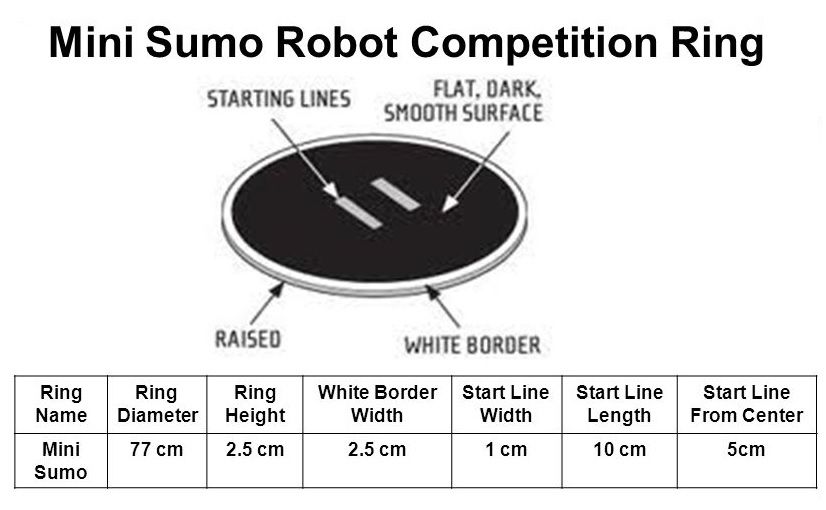
Each robot has to push the opponent out of the ring, in order to win the game. The one who stays in the ring for longer, wins. The maximum size of a sumo robot is 20cm x 20cm. The maximum weight of the robot is 1kg.
- Assessment: knock-out
Referees: Ann Stevens, Miguel Besas, Danny Ruse, Peter Duong Le, Darnbi Sakong, Daniel Ricardo, Jake Williamson, Adam Single, Lachlan Forbes, Yanti Surjaningsih, Dimitri Joukoff, Hoseop Lee,
National leaders
Australia: Ann Stevens, TAFE Queensland
Indonesia: Santoso Gondowidjojo, ROCI (Robotic Organizing Committee Indonesia) and Yanti Surjaningsih, Wikati Education
Korea: Chang Gyoon Lim, Chonnam National University, Debbie Suh, Ewha University
Philippines: Melvin Matulac, Pinoyrobotgames
Taiwan: Peichen Sun , National Kaohsiung Normal University
FAQ
- How to register the competition?
- for Australian students, visit https://www.griffith.edu.au/griffith-sciences/stem-outreach/technology-challenge/_nocache or contact j.jo@griffith.edu.au.
- for non-Australian students, contact your national leader (see the ‘Event chairs and national leaders‘ list below).
- Age Groups?
- Junior group (13yrs or younger)
- Senior group (14yrs or older)
- How many categories can I participate in?
- up to 3 categories.
- How big is the map for line-tracing / mission challenge?
- The “map.zip” file contains 4 distinct pieces, each measuring 160cm x 120cm.
- In the context of a competition, 2 out of the 4 pieces will be chosen at random, combined, and then utilised.
- The size of the combined map will be either 160cm x 240cm or 320cm x 120cm.
 Australian Robotics Association